O love that wilt not let me go
with
ST. MARGARET
[Indelible Grace]
I. Origins
George Matheson (1842–1906) was a Scottish pastor. Despite going blind as a teen, he was a theology student of distinction and a capable poet. In 1868, he had been appointed to a pastorate in Innellan. This hymn of his was written there. In his own account, he wrote:
My hymn was composed in the manse of Innellan on the evening of 6th June 1882. I was at that time alone. It was the day of my sister's marriage, and the rest of the family were staying overnight in Glasgow. Something had happened to me, which was known only to myself, and which caused me the most severe mental suffering. The hymn was the fruit of that suffering. It was the quickest bit of work I ever did in my life. I had the impression rather of having it dictated to me by some inward voice than of working it out myself. I am quite sure that the whole work was completed in five minutes, and equally sure that it never received at my hands any retouching or correction.[1]
In a similar account, provided to a contemporary historian, he said:
My hymn was the voice of my depression. It was not made for any utilitarian purpose; it was wrung out spontaneously from my heart. It is worthwhile observing this, because it was to me a unique experience. I have no natural gift of rhythm. All the other verses I have ever written are manufactured articles; this came like a day-spring from on high.[2]
From out of difficult circumstances came a hymn of great comfort, a beacon to many. Matheson’s recollection of writing it in June 1882 was faulty, because it was first printed in a periodical in Edinburgh called Life & Work: A Parish Magazine in January 1882. It carried a reference to 2 Corinthians 5:7, “If any man be in Christ, he is a new creature.”
Fig. 1. Life & Work: A Parish Magazine (January 1882).
Not long after, it was adopted into The Scottish Hymnal (Edinburgh: William Blackwood & Sons, 1884), words only, then The Scottish Hymnal with Tunes (Edinburgh: William Blackwood & Sons, 1885) with a tune by Albert L. Peace (1844–1912), organist of Glasgow Cathedral. Both examples feature a small change, from “climb the rainbow” to “trace the rainbow.” Matheson’s biographer relayed the story behind the composition of the tune:
As musical editor of The Scottish Hymnal, which at the time was passing through the hands of the Committee of the Church of Scotland, Dr. Peace was in the habit of always carrying in his pocket a copy of the words for careful study. Sitting one day on the sands at Arran, he was reading “O Love that wilt not let me go” when the tune came upon him like a flash, and, taking out his pencil, he dashed it off in a few minutes.[3]
A similar account was provided by the editors of the Handbook to the Church Hymnary (1935):
Dr. Peace wrote ST. MARGARET in Brodick Manse, Arran, in 1884. The Committee of The Scottish Hymnal (published in 1885) had requested him to compose a tune for this new hymn. “After reading it over carefully, I wrote the music straight off, and I may say that the ink of the first note was hardly dry when I had finished the tune.”[4]
Regarding the name of the tune, Carl P. Daw has asserted, “The tune name most likely honors Margaret of Scotland (ca. 1045–1093), a Hungarian princess who married the Scottish king Malcolm in 1070. She was well known for her personal piety and for her charity to the poor.”[5]
Fig. 2a. The Scottish Hymnal (Edinburgh: William Blackwood & Sons, 1884).
Fig. 2b. The Scottish Hymnal with Tunes (Edinburgh: William Blackwood & Sons, 1885).
The text was also included in Matheson’s Sacred Songs, 3rd ed. (Edinburgh: William Blackwood & Sons, 1904) as the final entry.
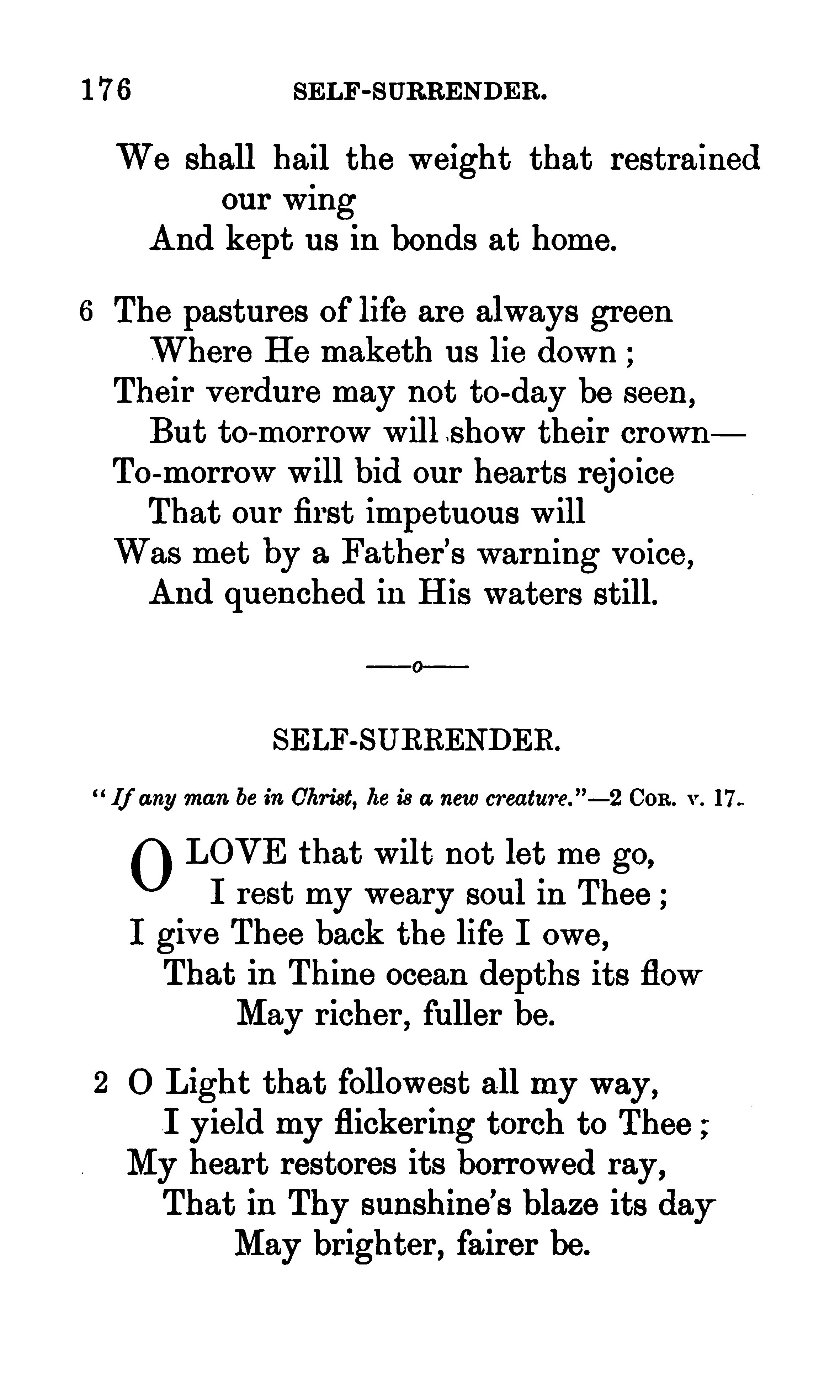
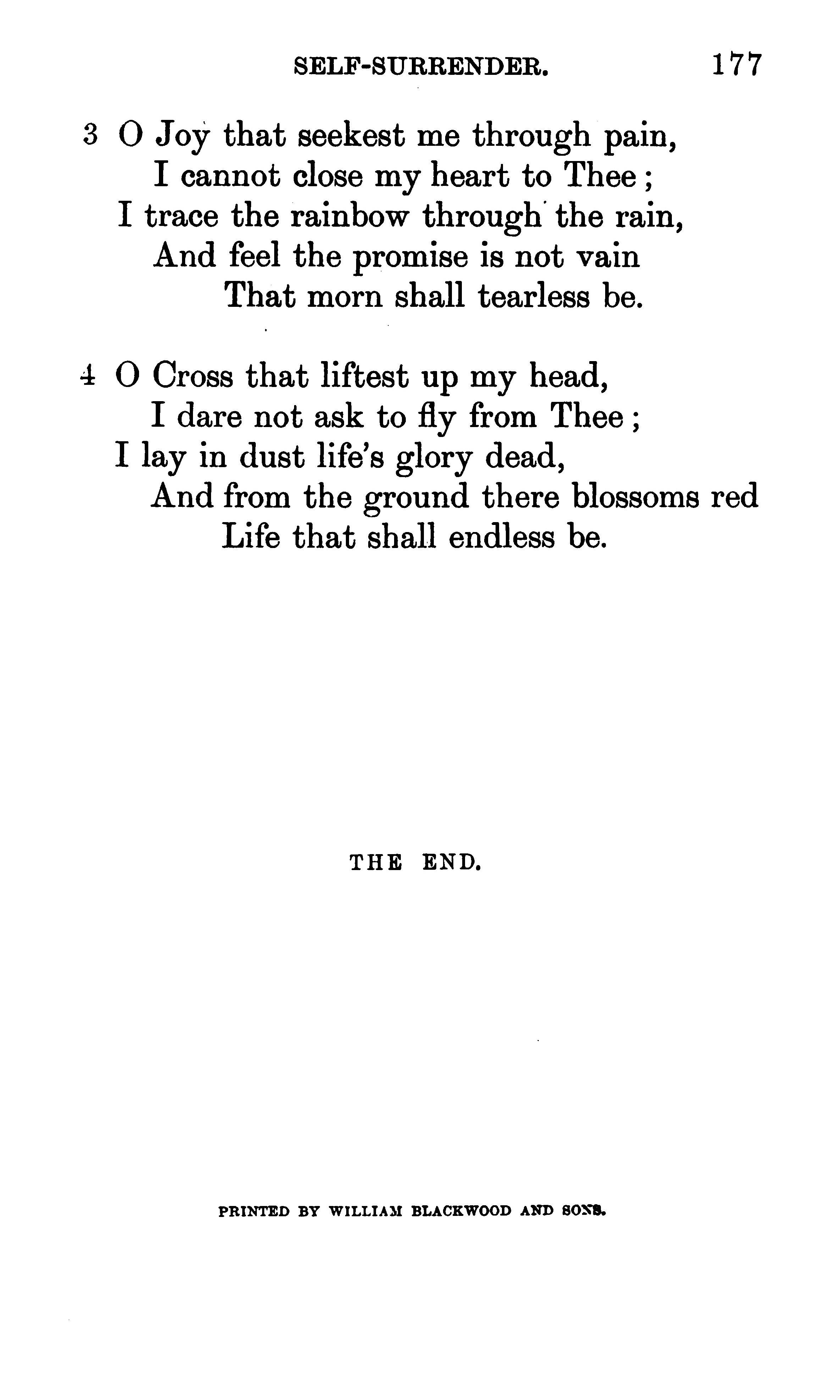
Fig. 3. Sacred Songs, 3rd ed. (Edinburgh: William Blackwood & Sons, 1904).
II. Text: Interpretation
Part of Matheson’s hymn says, “I trace the rainbow through the rain, and feel the promise is not vain.” Matheson wrote more about what this meant to him in his devotional book Moments on the Mount (1886), in the context of 2 Corinthians 5:14 (“The love of Christ constraineth us”):
My soul, marvel not that the love of God should first manifest itself in thy pain. Constraint is the first gift of all love — even of human fatherhood. Was not thine earthly childhood developed by sacrifice, by obedience to a law whose meaning thou couldst not see? Did not thine early intelligence expand through a path of tears, expand through the crushing of thine individual will and the constraint of thine impetuous passions? Thy path of tears was an unconscious rainbow; it led thy soul aloft on an arch of triumph. It was only from the summit of the arch that thou couldst tell how really glorious was thy path of tears. So shall it be with thy larger retrospect. When from the summit of a completed experience thou shalt look back, thou shalt marvel at the glory of the way. The most glorious spots of that way shall just be the spots that, when thou wert passing by, appeared to have no glory. The places which shall be most filled with light shall be thy dark places — the scenes that seemed to thee thy blots on the page of life. Thou shalt see that in these were thy true gifts of fortune. Thou shalt learn that the days called adverse were the making of thee, that the seasons of thy spiritual growth were the hours of thy night. And when thou countest up the gifts of Divine love, thou shalt class amongst the brightest of them all those that, in the course of the journey, came to thee as denials of thy prayer; thou shalt look upon the crosses of thy life and say, “The love of Christ constrained me.”[6]
The editors of the Handbook to the Church Hymnary (1935) reported:
Dr. Matheson used to explain that when he wrote “blossoms red” in the last verse, he was thinking of the blossom that comes out of sacrifice—of the sacrificial life which blossoms by shedding itself. “White” is the blossom of prosperity, “red” of self-sacrificing love.[7]
Hymn scholar Carl Daw believed the nuance of archaic suffixes held clues into Matheson’s intent:
One of the virtues of retaining the conventional archaic style in which Matheson wrote this text is that the preservation of the second-person-singular verbs (“wilt,” “followest,” “seekest,” “liftest”) proves instrumental in conveying how these lines are conceived as personification rather than as abstraction (which would require the third-person-singular forms: “will,” “followeth,” “seeketh,” and “lifteth”). The terms “Love,” “Light,” and “Joy” turn attributes of God into names for God (or possibly for the first Three Persons of the Trinity), and the final stanza may continue a long tradition of addressing Christ’s cross as a living entity, or it may be directed to the cross that each disciple if called to take up (Mt. 16:24, Mk. 8:34, Lk. 9:23).
The meter (8.8.8.8.6) is an unusual one, as is the abaab rhyme pattern. The structure is further complicated by the enjambment between each fourth and fifth line and by the use of the same b rhyme words in all four stanzas. The considerations of inversion and enjambment combine to make the sense of the final two lines of the text somewhat obscure. . . . The red blossom is the color of self-sacrifice, the pouring out of one’s own blood, which is the seat of life (as is reiterated several places in Hebrew Scripture, such as Leviticus 17:11). It may also be helpful to be mindful of other biblical allusions: 1.1, Romans 8:38–39; 1.3, 1 Chronicles 29:14b; 2.1, Psalm 27:1; John 8:12; 3.3, Genesis 9:12–17; 3.5, Psalm 30:5b; Revelation 21:4; 4.2, Psalm 139:7.[8]
The editors of the Companion to Church Hymnal (2005) identified some other possible points of interpretation:
There is an element of commitment and sacrifice in every stanza of the hymn: “I give thee back the life I owe” (st. 1); “I yield my flickering torch to thee” (st. 2); “I cannot close my heart to thee” (st. 3); “I lay in dust life’s glory dead (st. 4). In st. 2, Matheson used as a parable the lighted torch in the ancient Greek games, which is still a symbol of the Olympic Games today. In the relay race, the runner had to pass on the torch, still alight, to the next competitor. Matheson, in his depression, felt that his torch was going out, and so he was plunging it into the love of God to be rekindled.[9]
A poignant reflection and prayer on this hymn were written by Ida and Leslie Church for their book Begin with a Hymn (1957):
Have you read it quietly and pondered each verse? The Love that won’t let go—but offers you rest. The Light that gives to your eyes blinded by sorrow, sight to see God’s fairer day. The Joy that comes in the dark and sorrowful hour and points to daybreak without a cloud in the sky. The Cross that raises us when we have abandoned our selfishness and let Love in.
Forgive me, Lord, that I thought you had grown weary of my follies and my weakness. Give me the Light that helps me to see the inmost meaning of my life and of your purpose. Grant me courage and strength to endure, that I may know the joy of victory in me. Take me this day and use me as you will.[10]
III. Modern Tune
This hymn is known to many through the tune by Christopher Miner, first recorded on the premiere, self-titled Indelible Grace album (2000), sung by Sandra McCracken. The score was published via the RUF Hymnbook (2002) and on the Indelible Grace website. Miner recorded the tune himself on his album The Calm of Paradise (2002). McCracken has re-recorded the tune on By Thy Mercy: Indelible Grace Acoustic (2009) and on The Hymn Sing: Live in Nashville (2010), recorded at Ryman Auditorium 30 June 2010. Miner’s tune is considerably more energetic than the Scottish tune, perhaps expressing an exuberant gratefulness.
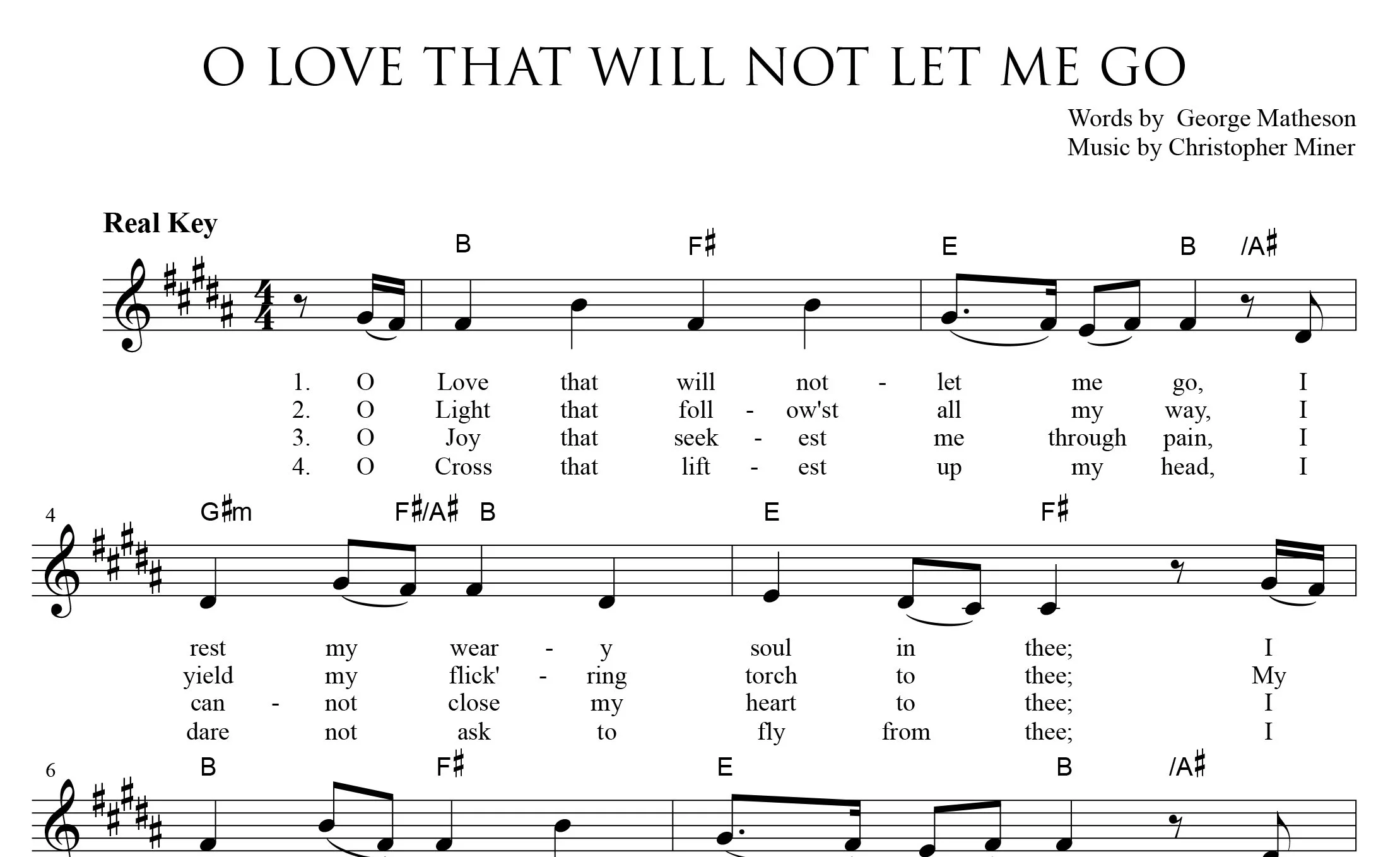
Fig. 4. Indelible Grace Hymnbook ©1997 Christopher Miner (excerpt).
Kevin Twit, founder of Indelible Grace, counts this hymn among his favorites. For his Teachable series (2020), he explained:
When you look at this hymn, this is a hymn born out of mental suffering, and it’s a hymn of one who has wrestled with God and come to a deep trust and a deep submission to God’s providence even in the midst of disappointments. That’s what this hymn is really about, and I love the way it begins: “O love that will not let me go.” I think about one of my favorite passages in the Bible; it’s in 1 John 4:16; it says, “And so we know and rely on the love God has for us.” Note, it does not say, “We rely on our love for God.” And I would just point out that it’s hard to rely on something if you don’t know very much about it. So I think this verse encourages us to do things. It encourages us to know what the love of God is about, and First John has got lots of stuff in there that can help us, as well as the rest of the Bible, of course. But also, to rely on the love God has for us, rather than our love for him.
I remember when I first got converted, early in my high school years, and feeling like, you know, I need to have a Bible study about every three or four days; I need to find some Christian group, because I feel like my religious feelings and my zeal for God kind of wanes after a few days, and so I kind of need a little pump-up. I think a lot of people even think of [congregational] worship kind of like that; it’s like, let’s get a little super charge of our batteries so we can go out and live the Christian life for at least a few more days. That’s not really what it’s about. Really, what the Christian life is about is knowing and relying on the love God has for us, resting in that. That’s a very different thing. That’s a paradigm-shifting verse.[11]
by CHRIS FENNER
for Hymnology Archive
14 June 2026
Footnotes:
Donald MacMillan, The Life of George Matheson (London: Hodder & Staughton, 1907), p. 181: Archive.org
John Brownlie, The Hymns and Hymn Writers of the Church Hymnary (London: H. Frowde, 1911), p. 225: Archive.org
MacMillan, The Life of George Matheson (1907), p. 190: Archive.org
James Moffatt & Millar Patrick, Handbook to Church Hymnary with Supplement (Oxford: University Press, 1935), p. 146.
Carl P. Daw Jr., Glory to God: A Companion (Louisville: Westminster John Knox, 2019), p. 794.
George Matheson, Moments on the Mount (NY: A.C. Armstrong, 1886), pp. 85–87: Archive.org
James Moffatt & Millar Patrick, Handbook to Church Hymnary with Supplement (Oxford: University Press, 1935), p. 146.
Carl P. Daw Jr., Glory to God: A Companion (Louisville: Westminster John Knox, 2019), p. 794.
Edward Darling & Donald Davison, Companion to Church Hymnal (Dublin: Columba, 2005), p. 777.
Ida & Leslie Church, Begin with a Hymn (London: Epworth, 1957), pp. 30–31.
Kevin Twit, “O love that will not let me go,” The Gospel in Hymns (Teachable, 2020): https://indeliblegrace.teachable.com/
Related Resources:
Louis Benson, “O love that wilt not let me go,” Studies on Familiar Hymns, Second Series (Philadelphia: Westminster Press, 1923), pp. 268–278: Archive.org
Kristyn Getty, “O love that wilt not let me go,” Family Hymn of the Month (Getty Music, Feb. 2024):
https://www.gettymusic.com/fhotm-february24
“O love that will not let me go,” Indelible Grace Hymnbook:
https://ighymns.herokuapp.com/hymns/o-love-that-will-not-let-me-go
“O love that will not let me go,” Hymnary.org:
https://hymnary.org/text/o_love_that_wilt_not_let_me_go
“O love that wilt not let me go,” Canterbury Dictionary of Hymnology:
http://www.hymnology.co.uk/o/o-love-that-wilt-not-let-me-go